
SQL vs ORM Is the Wrong Debate: Why Modern Applications Need Both
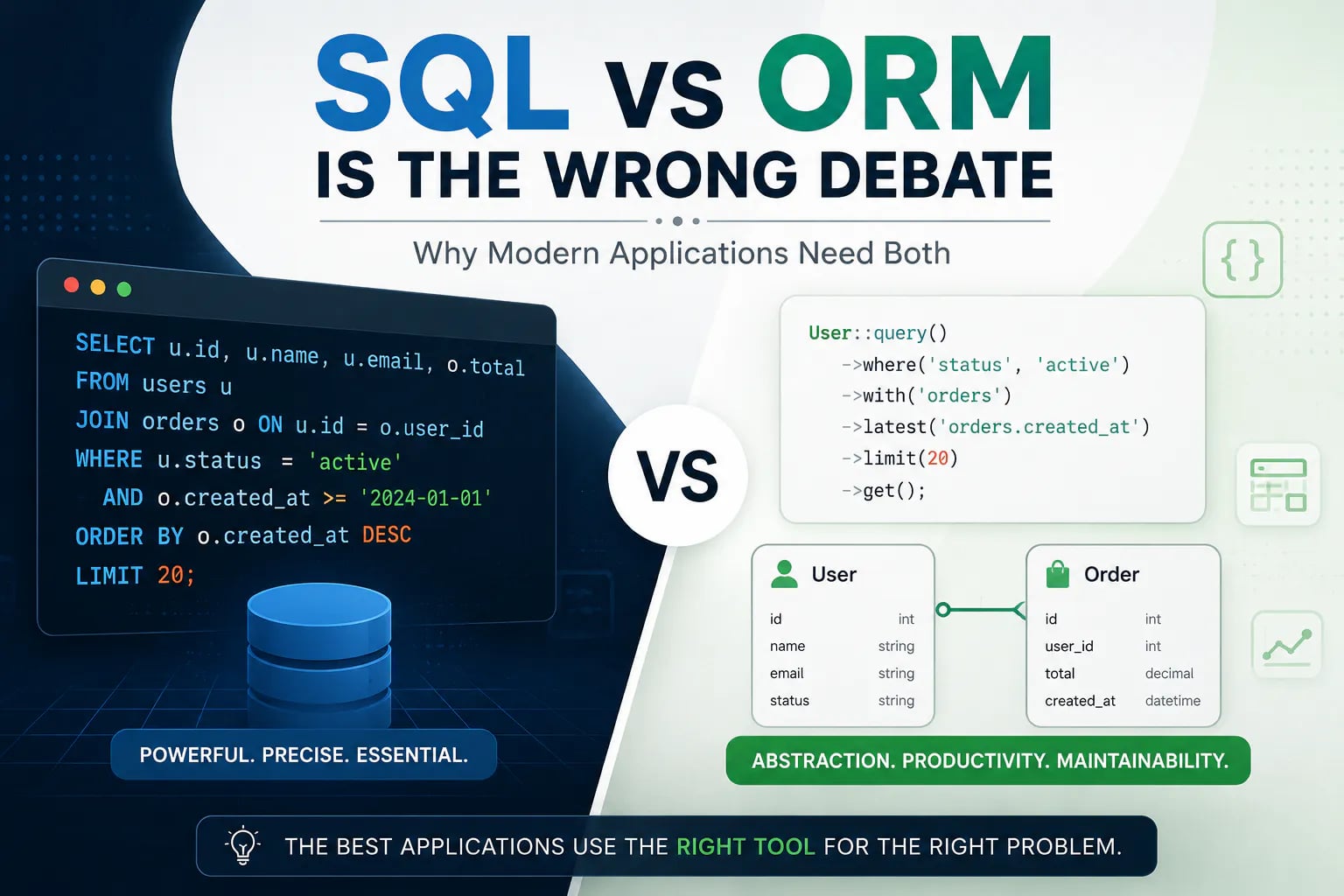
Every few months, someone writes another piece insisting developers should ditch their ORMs and “just learn SQL.” I get why that advice pops up. SQL really is foundational, and every backend developer should know their way around joins, indexes, transactions, execution plans, locking, and actually designing a schema. No argument there.
But I don’t buy the idea that learning SQL means you have to give up your ORM. After years working on real-world projects, I’ve seen how SQL and ORMs actually tackle different problems. SQL is how you talk to your database. ORMs step in at the application layer, helping you manage growing, complex codebases. Acting like these tools compete with each other just makes the whole discussion too simplistic for how we really build stuff today.
Using an ORM doesn’t give you a free pass to ignore SQL. Bad queries, missing indexes, and clunky joins will still hurt you whether you wrote them in pure SQL or created them through Laravel Eloquent, Prisma, SQLAlchemy, or Entity Framework. The engineers who stand out are the ones who get both the abstraction they work with and the SQL that's generated behind the scenes.
Once your application gets bigger, maintainability starts to matter a lot more than saving a couple lines of SQL here and there. ORMs let you keep your models, relationships, validation, and queries in one consistent, centralized spot. When the schema changes, your IDE, static analysis, and refactoring tools can show you exactly what needs updating before disaster strikes in production. Compare that with a pile of raw SQL scattered across controllers, repositories, services, and stored procs—something as simple as renaming a column can turn into a miserable game of search-and-replace, and you’ll only discover what you missed when things fail at runtime.
Dynamic queries really highlight this. Your typical API endpoint probably allows filters, sorting, searching, pagination, and relationships—all possibly in the same operation. ORMs and query builders make this stuff composable and reusable, so your code stays readable and testable, and automatically guards against SQL injection. Doing the same thing by hand with raw SQL gets messy fast. You’re left piecing together query strings and managing parameters, which becomes a maintenance headache as your requirements shift.
Managing transactions is another area where ORMs shine. Most modern frameworks offer helpers for transactions, nested transactions, rollbacks, and patterns like Unit of Work. This means you can define the boundaries of your transaction once and trust the framework to handle everything—even complex operations with multiple service calls—without having to coordinate BEGIN, COMMIT, and ROLLBACK everywhere yourself. It cuts down on boilerplate and makes the flow of your application much easier to follow.
Now, the most common complaint against ORMs is about performance, and sometimes that’s fair. Big analytical queries, bulk imports, recursive CTEs, window functions, and certain database tricks really are easier and often faster to write in plain SQL. But guess what? Using an ORM doesn’t stop you from falling back to raw SQL when it makes sense. Almost every decent ORM has an escape hatch for exactly this reason—you can use SQL directly when you need to, but keep the productivity boost from your ORM the rest of the time.
What actually matters is real, measured performance. Before you rip out an abstraction, profile your queries, look at execution plans, check your indexes, and figure out what’s actually slowing things down. In plenty of real-world apps, issues like slow networks or bad schema design eat up far more time than the relatively minor overhead ORMs introduce.
Let’s talk about stored procedures for a second. They have their place—great for certain batch tasks, heavyweight reporting, or when you need to run logic close to your data for a real performance boost. But use them for specific technical reasons, not just to avoid using an ORM. When you bury your business logic in stored procs, you end up dividing your code across different languages, toolchains, and deployment processes. Testing and debugging get harder, and updates become a bigger pain in the neck.
So here’s the practical way forward—pick the right tool for each job. Use your ORM for everyday CRUD, relationships, business logic, and most workflows. Reach for a query builder when you don’t need full model hydration but still want readable, flexible queries. Use SQL directly for those performance-critical queries or advanced database features ORMs can’t handle well. Turn to stored procs only when they’ll genuinely make things better or faster, not just because you distrust higher-level abstractions.
The best teams don’t get hung up on ideology. They’re pragmatic. They want code that’s understandable and easy to change, not just “technically correct” in some purist sense.
Learning SQL is non-negotiable. Every backend engineer should really know how relational databases work, how queries play out, and how to fine-tune them. But adding SQL skills should expand your toolkit, not close you off to tools like ORMs that improve maintainability, consistency, and the speed of development—and still let you drop down to raw SQL when you need to.
So it’s not really about “ORM or SQL?” The smarter question is: “Which tool makes the most sense for me right now?”
